88 Constellations Collection
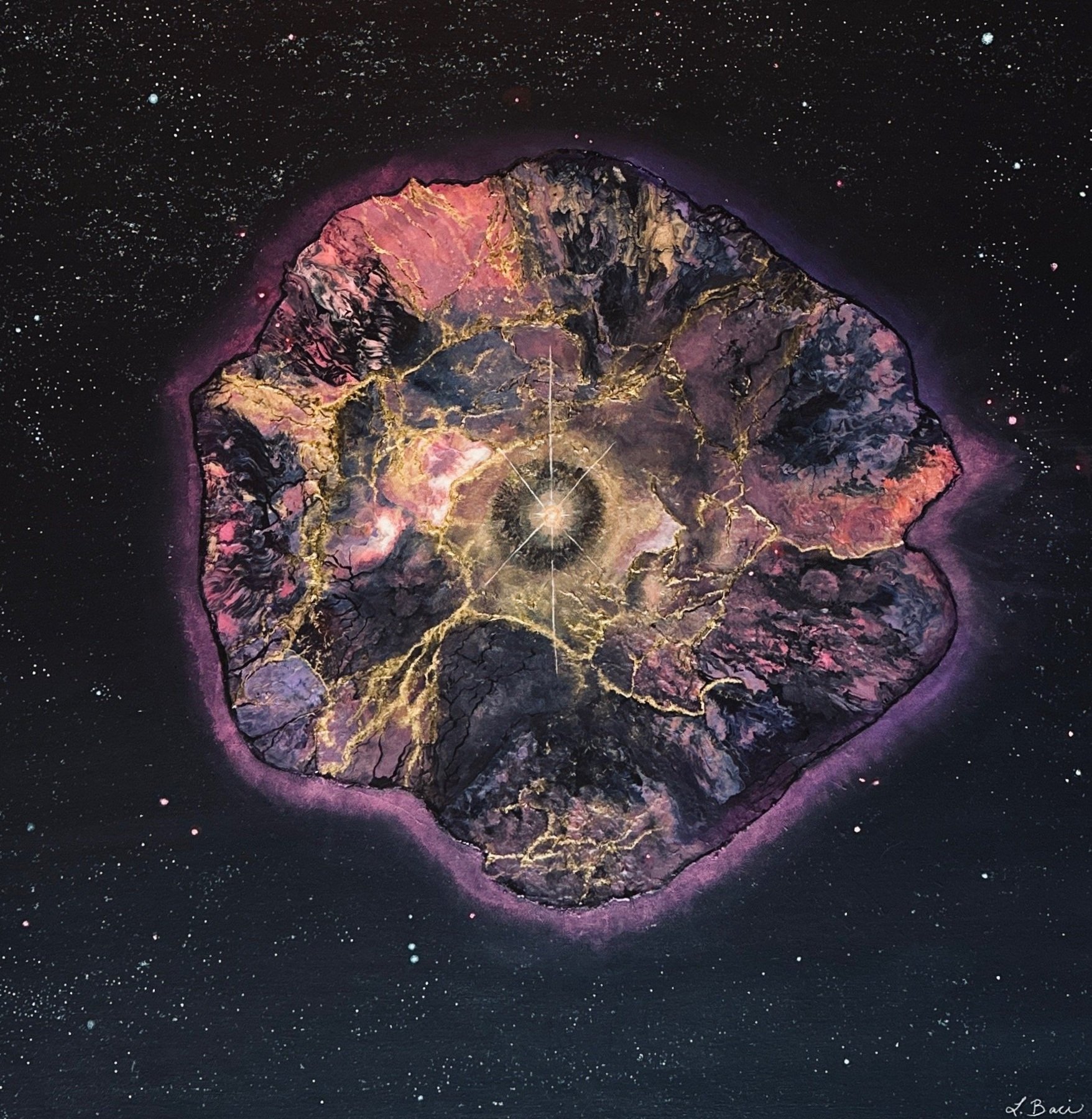
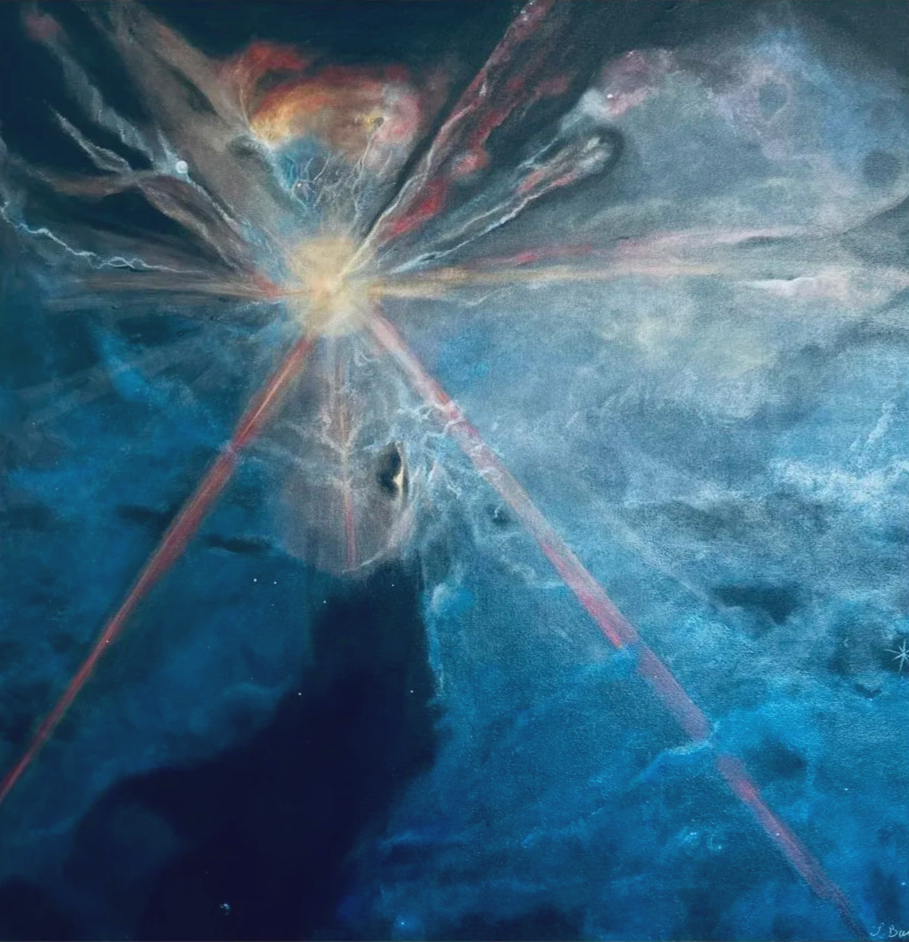
There are 88 constellations in our night sky — every star, every direction, mapped and named. This collection is my journey through them all, painted the way I feel them: quiet, vast, and full of peace — the cosmos reminding us we are all one.
2025
Acrylic on canvas.
8” × 8” × 11/16” (20.3 × 20.3 × 1.76 cm)
Sold in a 9” × 9” brown wood grain floating frame.
This artwork of the Helix Nebula, or Caldwell 63, from the Aquarius Constellation, features a striking mix of warm reds and cool ocean blues. The bright colors represent important elements—oxygen, nitrogen, hydrogen, and calcium—that make up our bodies and connect us to this celestial beauty.
2025
Acrylic on canvas.
8” × 8” × 11/16” (20.3 × 20.3 × 1.76 cm)
Sold in a 9” × 9” brown wood grain floating frame.
Beehive Cluster (also known as Praesepe (Latin for "manger", "cot" or "crib"), M44, NGC 2632, or Cr 189), is an open cluster in the constellation Cancer. One of the nearest open clusters to Earth, Ptolemy described it as a "nebulous mass in the breast of Cancer". It was among the first objects that Galileo studied with his telescope.
2025
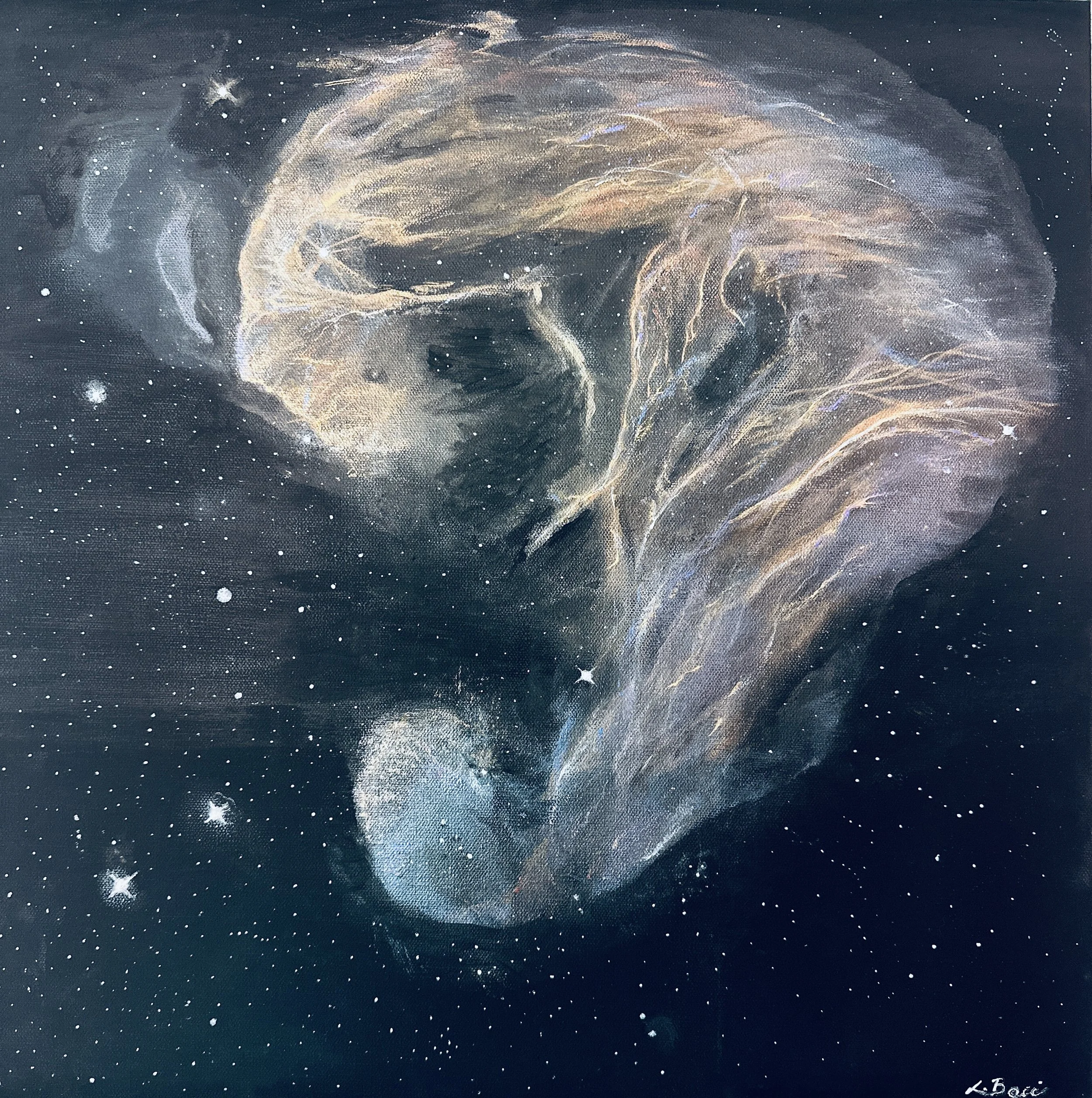
Born from a star’s last breath, this nebula dances on the canvas, inspired from an image captured by Hubble Space Telescope. This shows just a small fraction of the Veil Nebula; if you could see the entire nebula without the aid of a telescope, it would be as wide as six full Moons placed side by side.
It’s wild… yet peaceful — just like the night sky. Flowing forms of red, white, blue, and gold sweep across a deep black background, echoing the nebula’s cosmic filaments and creating a powerful sense of movement and light.
12 × 12 × 11/16 in. (30.5 × 30.5 × 1.8 cm)
Sold in 13 × 13 in. black floating frame.
2024
Acrylic on canvas.
12 × 12 × 11/16 in. (30.5 × 30.5 × 1.8 cm)
Sold in a 13” × 13” brown wood grain floating frame.
This painting captures the mesmerizing edge of the Coalsack Nebula (Caldwell 99), a dark, inky cloud of interstellar dust in the constellation Crux, in the heart of the cloud the artist imprinted a face. From shadow to light, transformation is always unfolding in and around us.
Pareidolia: the ability to see shapes in the cosmos, can you find Salvador Dali in the inky blue nebula?
2025
Acrylic on canvas.
12 × 12 × 11/16 in. (30.5 × 30.5 × 1.8 cm)
Sold in a 13” × 13” brown wood grain floating frame
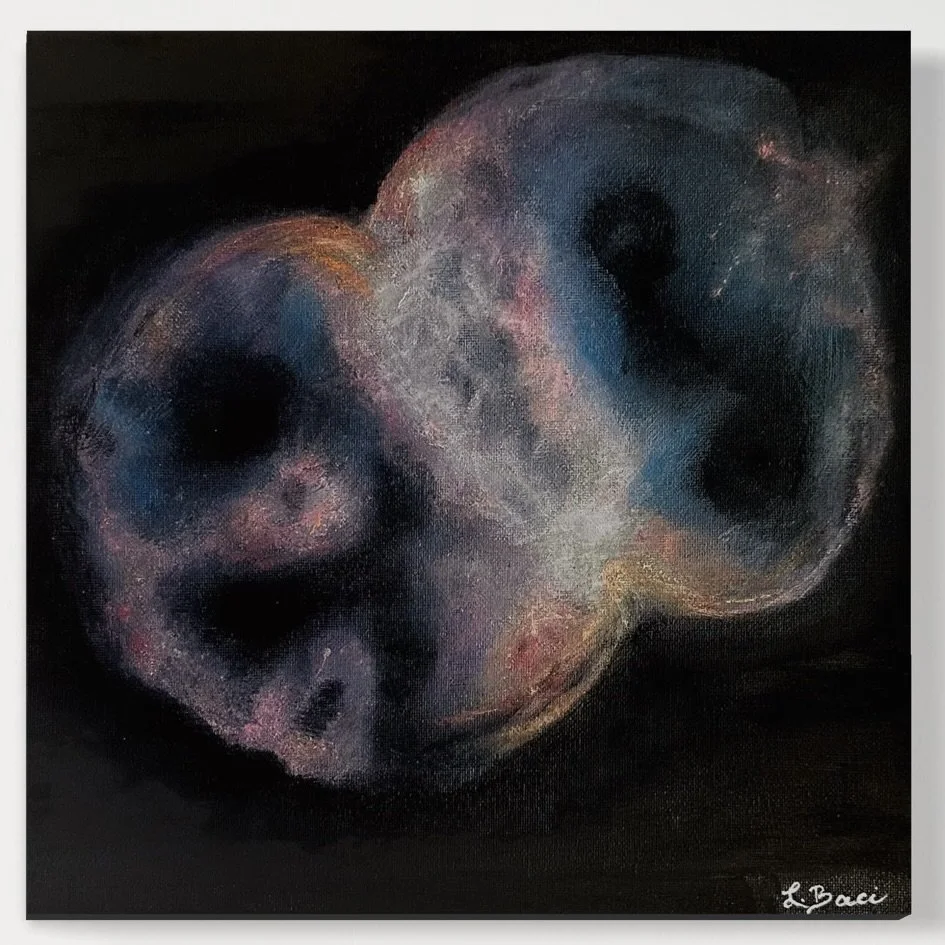
If you can’t laugh at art, you’re taking it too seriously. We all need more play and laughter. That’s why I had to paint this two-lobed structure of glowing, mottled gas — the Dumbbell Nebula, in the constellation Perseus, a dying star at the center is deflating, causing superheated gases to glow and expand.
2025
Acrylic on canvas
20 × 20 × 1.5 in. (50.8 × 50.8 × 3.81 cm.)
Custom (framed) in 20 × 20 in. dark wood grain floating frame
This painting is delicate and richly layered, creating a sense of depth that allows the forms to appear as though they are gently floating across the canvas. Each element was meticulously applied using needles, emphasizing precision, patience, and intentional mark-making throughout the process. The work is inspired by a NASA image of the star cluster NGC 602, whose whimsical yet highly detailed reality informed both the composition and atmosphere of the piece.
2025
Acrylic on canvas
20 × 20 × 1.5 in. (50.8 × 50.8 × 3.81 cm.)
Custom (framed) 20 × 20 in. dark wood grain floating frame
This painting reflects a sense of movement and wonder. The composition evokes energy, transformation, and quiet resilience. Inspired by the NASA image of the supernova remnant N49, the fine strands of light create an intricate, almost lace-like structure, suggesting energy, movement, and rebirth after destruction.
2025
Acrylic on canvas
20 × 20 × 1.5 in. (50.8 × 50.8 × 3.81 cm.)
Custom (framed) 20 × 20 in. dark wood grain floating frame
By utilizing a meticulous application technique to layer luminous acrylics beneath a dominant black ground, the work manifests a sophisticated chiaroscuro that mirrors Jungian "shadow work." This process-driven reversal where darkness is not merely an absence but a structural layer recontextualizes the Rosette Nebula as a space where suppressed radiance and profound depth converge to form a cohesive, transformative whole.
2026
Acrylic on Canvas
60 × 48 × 1.5 in. (154.4 × 121.9 × 3.8 cm)
Custom (framed) in 36 × 36 in. bronze mixed metal floating frame
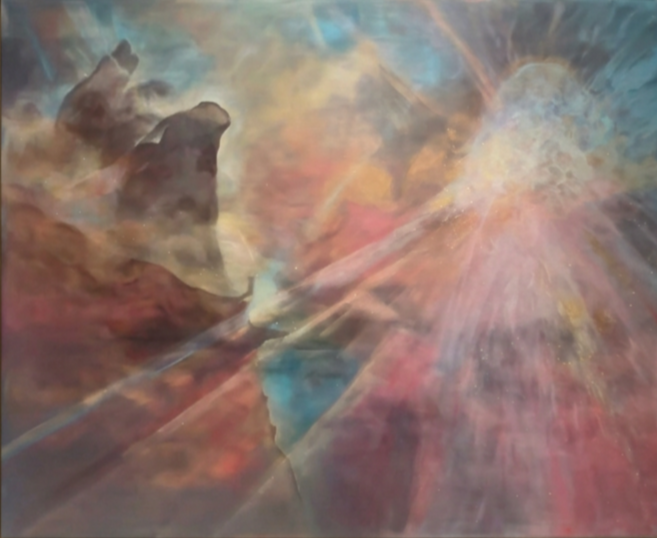
A reflection of the beginning of time, the present moment, and the future still unfolding, this piece is a tribute to the infinite beauty, mystery, and energy woven throughout our universe. Inspired by the famous NASA image of the Carina Nebula, the painting captures a cosmic mosaic of natural history — from the birth of stars to the remnants of a supernova. The work reflects the ever-changing journey of life, from beginning to end, with each moment revealing its own beauty, transformation, and grace.
2025
Mixed Media
36 × 36 × 1.5 in. (91.4 × 91.4 × 3.8 cm)
Custom (framed) in 36 × 36 in. dark wooden grain floating frame
WR 124 is a rare, massive Wolf–Rayet star surrounded by the turbulent nebula M1-67, formed by its violent mass loss. Wolf–Rayet stars burn hot and die young, often ending their lives as supernovae or black holes. Seeing this massive star shed its outer layers, only to reveal a more powerful, illuminated version of itself, serves as a reminder that trauma can strip away our stability and force us to shed parts of who we are; yet it is a process that reshapes us. What reemerges from the destruction is an undeniable strength and beauty.
2025
Acrylic on Canvas
36 × 36 × 1.5 in. (91.4 × 91.4 × 3.8 cm)
Custom (framed) in 36 × 36 in. dark wood grain floating frame
At the center is a star nursery, a place where dreamy meditation and fanciful musing come to life in what is known as Nebula N97 a region in the Large Magellanic Cloud. Imaged by the James Webb Space Telescope, revealing that heavenly places and rebirth are in motion right above us.
2024
Acrylic on canvas.
8” × 8” × 11/16” (20.3 × 20.3 × 1.76 cm)
Sold in a 9” × 9” brown wood grain floating frame.
The story of the Antennae Galaxies can be beautifully likened to the mythical love story of Orpheus and Eurydice-a love that transcends the boundaries of life and death but is fraught with longing and inevitable loss. For 100 million years, these galaxies have been locked in a transformative and tumultuous embrace, their attraction reshaping their fate. This cosmic collision will end with the merging of their nuclei forming one colossal elliptical galaxy or the death of one. It is a cosmic Shakespearean love story.