DANCING RING
Wolf-Star 124
✩
Wolf-Star 124 ✩
Our own lives, at times, can become chaotic and unpredictable. As we work through changing events affecting our internal and external worlds/. We can be taught by the stars that is a natural process to expel what no longer serves us, creating space for something new. The authenticity of this transformation is reflected in the ever-changing and ultimately exploding star, MR 124.
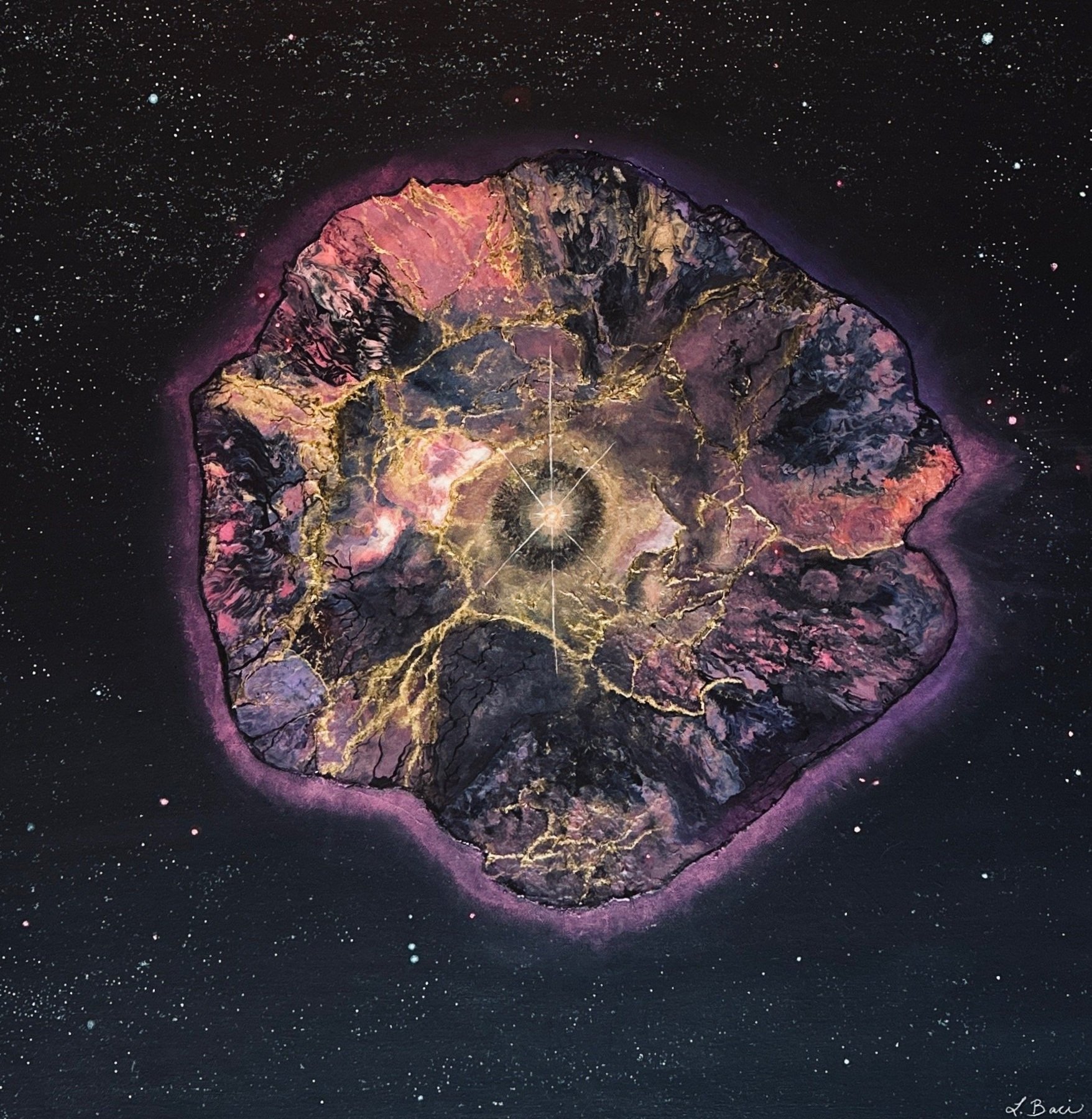
DANCING RING Acrylic on Canvas 36 x 36 x 1.5 in (91.4 x 91.4 x 3.8 cm) $4,200.00
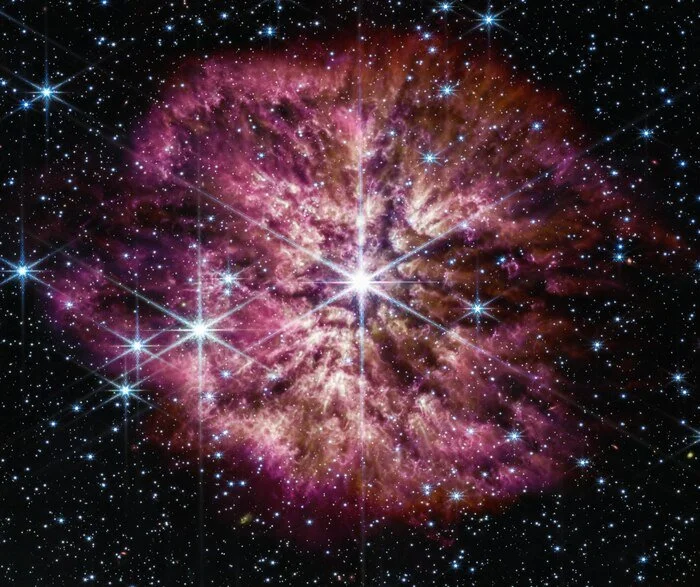
The artist painted MR 124 and M1-67, one a massive star nearing the end of its life, the other a nebula formed from the violent shedding of what was once a brilliant star. They are a famous pair: a hot, massive Wolf-Rayet star violently ejecting its outer layers, forming a young, expanding nebula (M1-67) around it. This process reveals clumps of gas and dust approximately 15,000 light-years away in the constellation Sagitta, serving as a prelude to its eventual supernova explosion.
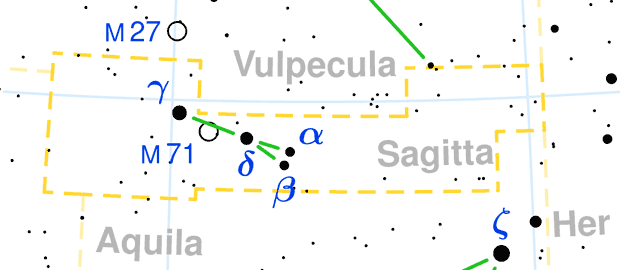
Sagitta is one of the 48 constellations first cataloged by the Greek astronomer Ptolemy in the second century. Its name is Latin for “arrow”. There are a number of Greek myths associated with this constellation. In one, it represented the arrow Hercules used to kill the eagle that Zeus sent to chew on Prometheus’ liver. In this version, the eagle is represented by the constellation Aquila. In another myth, it may represent the arrow that Apollo used to kill the Cyclopes. In still another myth it represents the arrow of Eros which made Zeus fall in love with Ganymede. In this version, the eagle guards the arrow in the sky.
Galatic Location: Sagitta Constellation
Celestial Phenomenon: Wolf-Star 124 & M1-67
Collection: 88 Constellations