KISS MY NEBULA
M 76
✩
M 76 ✩
This painting captures a quiet truth of the universe: nothing is ever truly lost. As a star reaches the end of its life, it sheds its outer layers, releasing the elements that will one day form new stars, planets, and life itself. This nebula stands as a metaphor for the life cycle:
“Death as transformation, and creation born from release, reminding us that we are, quite literally, made of stardust.”
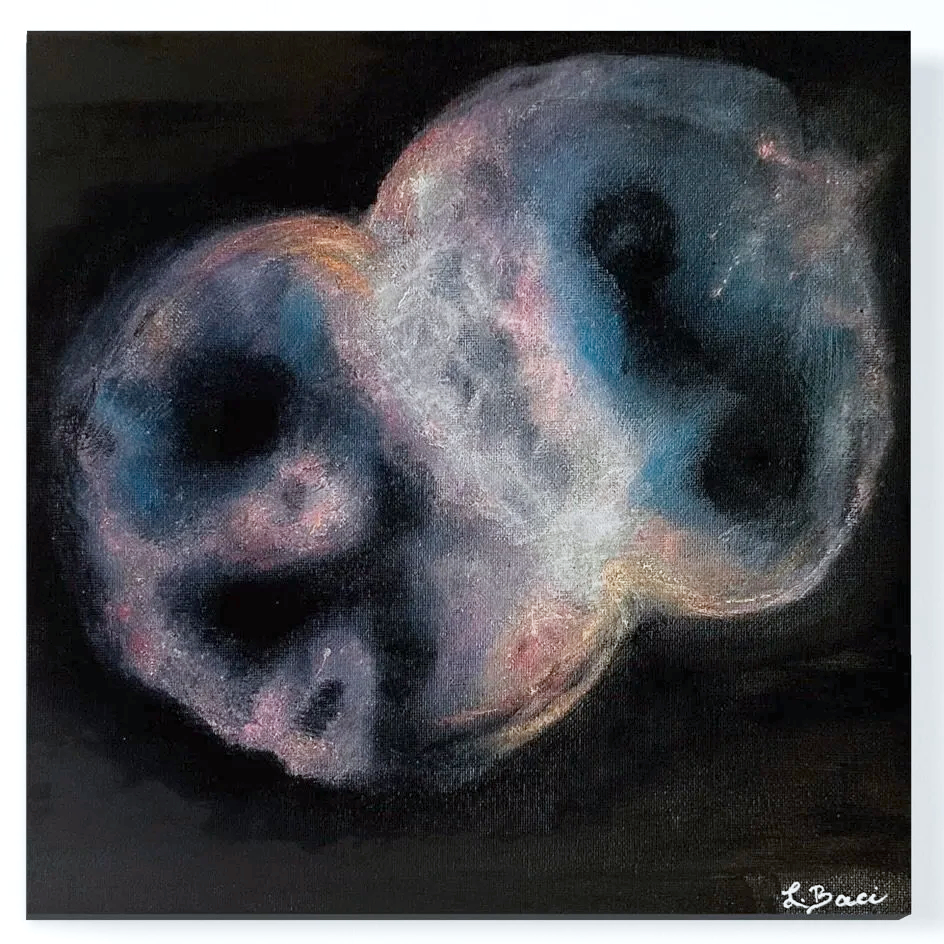
KISS MY NEBULA Acrylic on Canvas 12 x 12 x 1.5 in (30.5 x 30.5 x 1.8 cm) $350.00
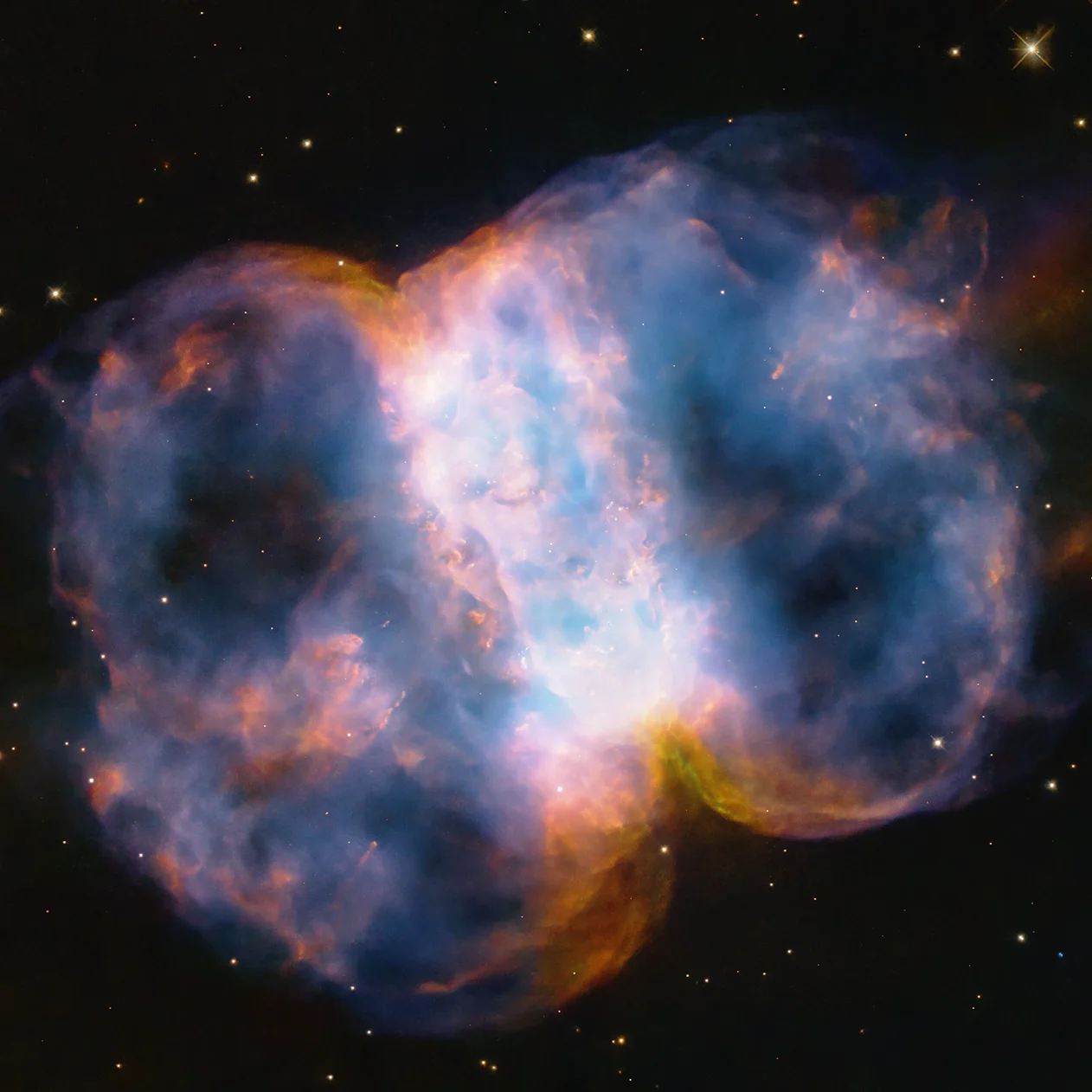
Image from NASA Hubble Space Telescope
Hubble shows the Little Dumbbell Nebula (M76), also called the Cork or Barbell Nebula. It has two lobes, giving a pinched, dumbbell-like shape. M76—listed as NGC 650 and NGC 651 when once thought double—is a planetary nebula (an expanding shell around a dying star), one of four in Messier’s catalog. It lies in Perseus about 3,400 light-years away.
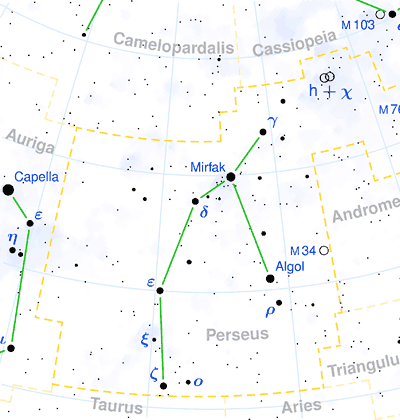
Perseus was first cataloged in the second century by the Greek astronomer Ptolemy. It is named after the legendary hero who rescued Andromeda from the sea monster, Cetus. Perseus was the son of Danaë, who was the daughter of King Acrisius. His father was the god Zeus. Perseus was sent by King Polydectes to slay the evil gorgon sister Medusa, whose gaze could turn anyone who looked at her into stone. Perseus slew Medusa in her sleep and collected her head in a bag. On his way back home, he spotted the princess Andromeda chained to a rock. She was to be sacrificed to the sea monster Cetus. Perseus used the head of Medusa to turn the monster into stone. Perseus and Andromeda fell in love and were both placed among the stars..
Galatic Location: Perseus Constellation
Celestial Phenomenon: N 76
Collection: 88 Constellations