FLAMING STAR
IC 405
✩
IC 405 ✩
The story of this star ‘Flaming Star Nebula’ is one of the brightest in the night sky. Once a binary star, meaing it was paired for what is normally its lifespan with another star, is tragic yet ends in such beauty. It collided with another pair of stars and was flung into space a collision was so violent that it ejected the star, sending it fleeing through space at incredible speeds (a "runaway" star).
Floating into deep space devoid of its partner untillit found a a nebula, to call home, it than began to it illuminated the material from within. Now, it burns brightly in the Auriga constellation.
Igniting everything around it; a reminder that if we trust the flow of the universe to land us exactly where we are meant to be, our light can bring beauty to all that surrounds us.
The story of this star, the Flaming Star Nebula, is one of the brightest star in our night sky.
Once part of a binary system: paired with another star for what is typically its entire lifespan; its story is tragic, yet it ends in great beauty. After colliding with another pair of stars, it was flung into space as a lost “runaway star.”
Floating through deep space, devoid of its partner, it wandered until it found a nebula to call home. There, it began to illuminate the surrounding material from within. Today, it burns brightly in the constellation Auriga.
Igniting everything around it, this star serves as a reminder that when we trust the flow of the universe to place us exactly where we are meant to be, our light can bring beauty to all that surrounds us.

FLAMING STAR Acrylic on Canvas 12 x 12 x 1.5 in (30.5 x 30.5 x 1.8 cm) $500.00
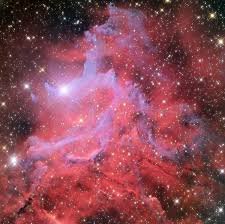
Image from NASA Hubble Space Telescope
A runaway star illuminates the Flaming Star Nebula in this striking cosmic scene. Also known as IC 405, the nebula’s billowing clouds of gas and dust lie approximately 1,500 light-years away in the direction of the constellation Auriga. The bright star visible in the upper left of the frame is AE Aurigae, a massive and intensely hot O-type star racing through space. It is believed to have been violently ejected millions of years ago after a collision between multiple star systems near the Orion Nebula.
Now passing close to IC 405, AE Aurigae’s high-speed journey energizes the surrounding nebula. Its powerful ultraviolet radiation ionizes the hydrogen gas, producing the nebula’s glowing reddish hues as electrons are stripped away and then recombine. At the same time, the star’s intense blue light is reflected by delicate filaments of interstellar dust, adding depth and contrast to the scene.
Like all massive stars, AE Aurigae is destined for a short but dramatic life. It burns through its nuclear fuel at a furious pace and will ultimately end in a brilliant supernova explosion. This colorful telescopic view spans roughly five light-years across at the estimated distance of the Flaming Star Nebula.
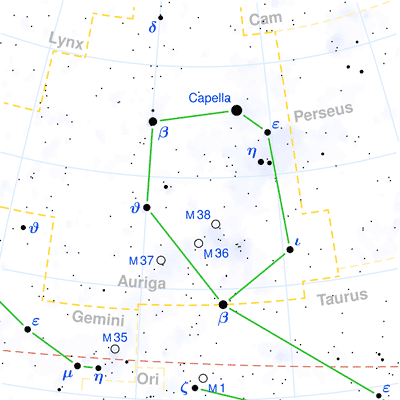
Auriga is one of the 48 constellations first listed by the Greek astronomer Ptolemy in the second century. The name means “the charioteer” in Latin. It is an ancient constellation with roots in many cultures. It was first recognized in Mesopotamia as a scimitar or crook. The crook stood for a goat-herd or shepherd. To the ancient Bedouin astronomers, the constellation represented a herd of goats. The Chinese saw it as Wuche, the five chariots of the celestial emperors and the representation of the grain harvest. In Greek mythology, it represented the charioteer Erechtheus, who is seen carrying his children in his arm. This constellation is believed to have originated with the Babylonians. In some references, the charioteer carries a goat along with the two children. His other hand holds the reins to the chariot.
The light from the Flaming Star Nebula currently being observed on Earth began its journey approximately 1,500 years ago, placing its origin around the time often associated with the legends of King Arthur in post-Roman Britain.
Galatic Location: Auriga Constellation
Celestial Phenomenon: IC 405
Collection: 88 Constellations