HOMUNOCULUS NEBULA
NGC 3372
✩
NGC 3372 ✩
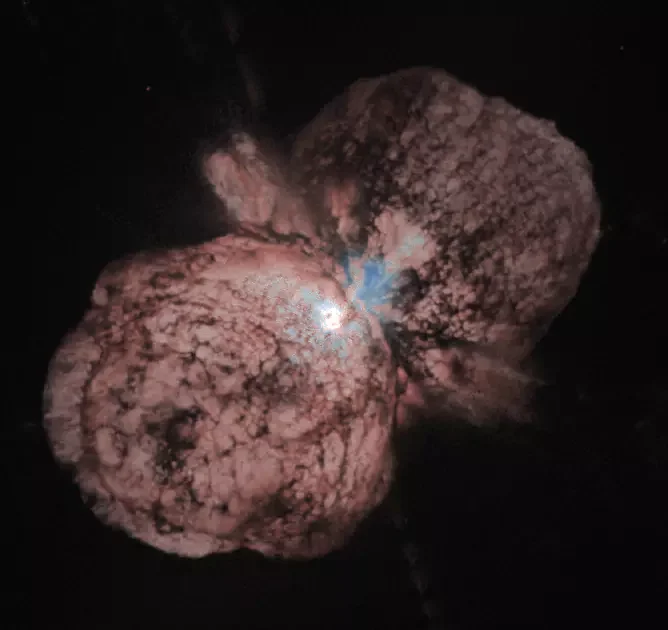
This abstract painting of the nebula within the luminous hypergiant Eta Carina — about 150 times the mass of our Sun — lies a smaller feature called the Homunculus Nebula (Latin for “Little Man”). It is harnessing immense energy, on the brink of eruption. The Homunculus Nebula is unique in the Carina constellation—and the sky—primarily because it is a recently formed, rapidly expanding "frozen explosion" (supernova impostor) that provides a direct view into the violent, ongoing life of the most massive stellar systems in the galaxy.
Like us, if we do not express our inner truth, that energy turns volatile and manifests in other ways.

Homunuculus Nebula Mixed Media on Canvas 20 × 20 × 1.5 in. (50.8 × 50.8 × 3.81 cm.) $1,250.00
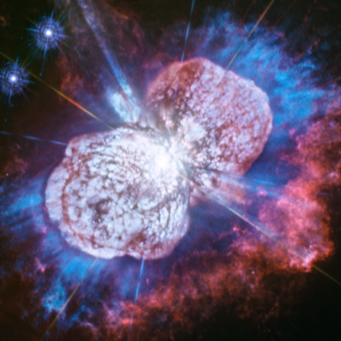
Image from NASA Hubble Space Telescope
Carina is famous as the home of the bright star Canopis. It is the brightest star in the constellation and the second brightest star in the night sky with a visual magnitude of -0.74. It is a blue-white supergiant star that is 13,600 times brighter than the Sun. It is located approximately 310 light years from Earth.
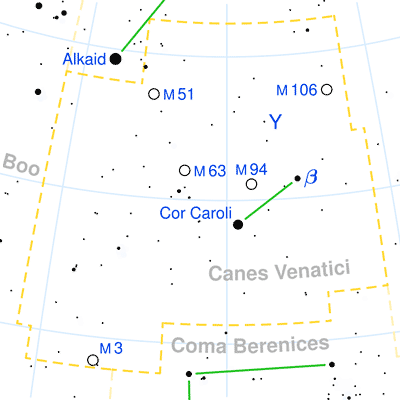
Carina was once part of a larger constellation called Argo Navis. This larger constellation represented the great ship of Jason and the Argonauts on their voyage to find the golden fleece. Argo Navis was one of the 48 constellations first listed by the Greek astronomer Ptolemy in the second century. This constellation was later divided by the French astronomer Nicolas Louis de Lacaille into three smaller parts. Carina became the Keel, Puppis the Stern, and Vela the Sails. These three smaller constellations were added to the official list of modern constellations in the early 20th century by the International Astronomical Union (IAU).
Galatic Location: Canes Constellation
Celestial Phenomenon: NGC 7372
Collection: 88 Constellations