COSMIC DANCE
M51a & M51b
✩
M51a & M51b ✩
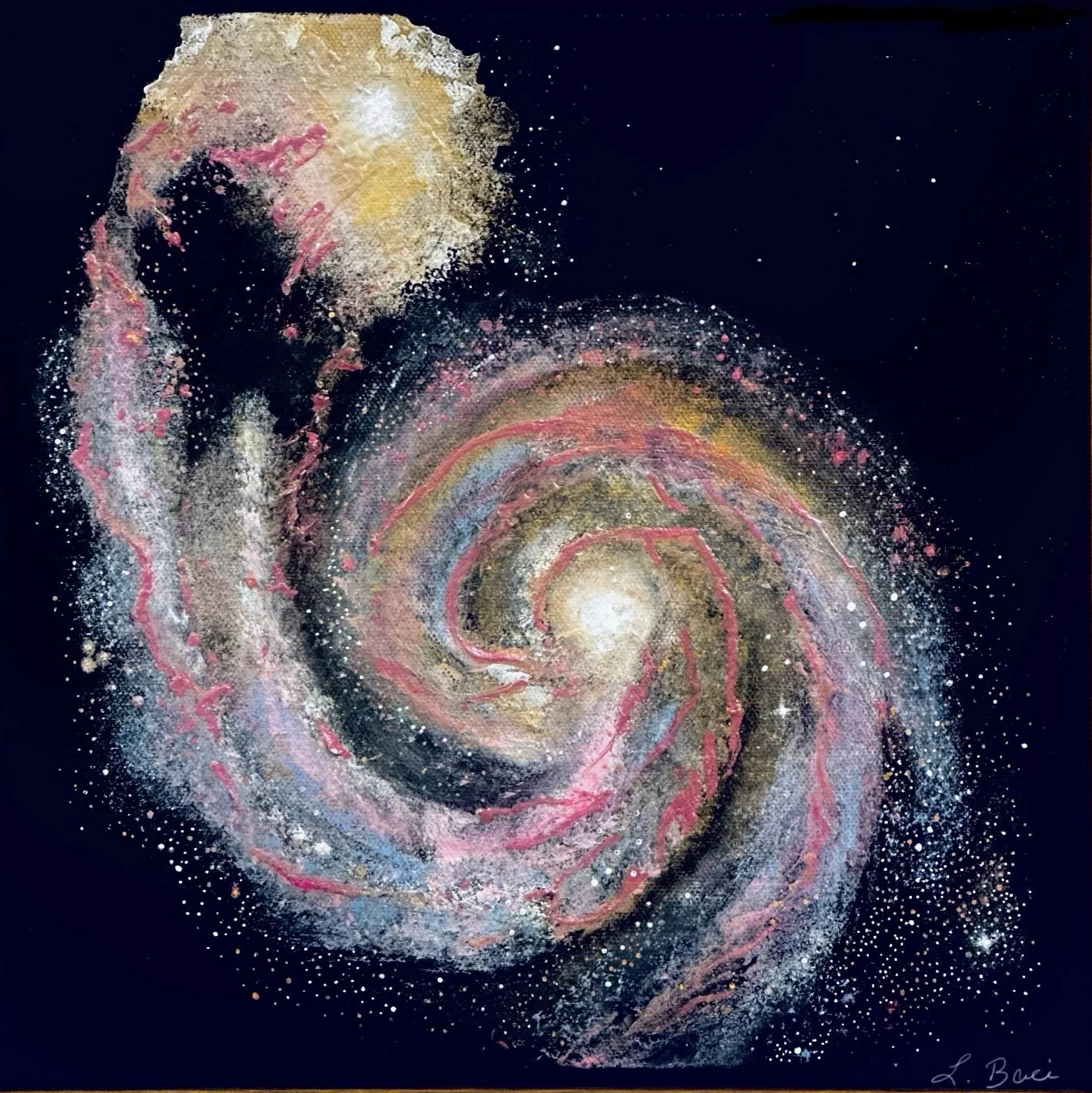
COSMIC DANCE Acrylic on Canvas 12 x 12 x 1.5 in (30.5 x 30.5 x 1.8 cm) $500.00
The Whirlpool Galaxy, one of the most beautiful face-on spiral galaxies in the sky, with dark dust lanes and red nebulas easily visible. This piece captures the dynamic interaction between two galaxies M51a and its companion, the dwarf galaxy M51b. Their cosmic dance, shaped by gravity’s pull, evokes the complexity of human relationships. Just as the gravitational forces between M51a and M51b reshape their forms, human connections can profoundly alter individual paths ultimately transforming each other over time.

Image from NASA Hubble Space Telescope
The Whirlpool's most striking feature is its two curving arms, a hallmark of so-called grand-design spiral galaxies. Many spiral galaxies possess numerous, loosely shaped arms which make their spiral structure less pronounced. These arms serve an important purpose in spiral galaxies. They are star-formation factories, compressing hydrogen gas and creating clusters of new stars. In the Whirlpool, the assembly line begins with the dark clouds of gas on the inner edge, then moves to bright pink star-forming regions, and ends with the brilliant blue star clusters along the outer edge.
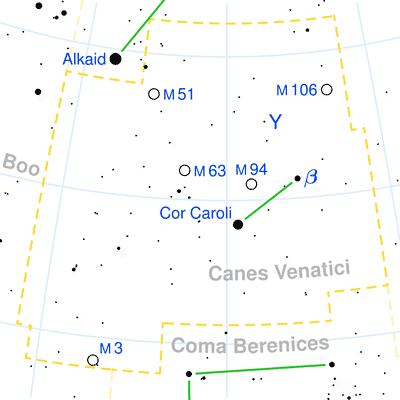
Canes Venatici was originally included in the constellation Ursa Major by the Greek astronomer Ptolemy in the second century. The constellation’s name means “hunting dogs” in Latin. There are no myths associated with this constellation. It represents the hunting dogs, Asterion and Chara, held by Boötes as he hunts for the bears Ursa Major and Ursa Minor in the night sky. The two dogs were first depicted with Boötes on a map by the German astronomer Peter Apian in 1533. The stars were separated out by the Polish astronomer Johannes Hevelius in 1687. He took the faint stars under the bear’s tail and formed the modern constellation Canes Venatici.
Galatic Location: Canes Vanatici Constellation
Celestial Phenomenon: M51a & M51b
Collection: 88 Constellations